
Your competitor just announced a new feature.
A customer crisis is brewing on social media.
Your supply chain hit a snag.
Oh, and your boss wants that decision by end of day.
Welcome to 2026, where the speed of business feels less like a marathon and more like a dogfight at Mach 2.
Here’s the thing: if there’s a decision making framework that helped fighter pilots make life-or-death choices while flying near supersonic speeds and being shot at, wouldn’t you want that for your business?
The answer is the OODA Loop. And it’s more relevant in 2026 than ever.
Fighter Pilot Wisdom for Desk Pilots
John Boyd was a United States Air Force fighter pilot and military strategist who understood something critical: in combat, the person who can observe, process, decide, and act faster than their opponent wins. Not the person with the bigger weapon. Not the person with more resources. The faster thinker.
Boyd developed the OODA Loop in the 1950s and ’60s, and it became the foundation of modern military strategy. But here’s what makes it powerful for business: it’s not about being reckless. It’s about being deliberately faster.
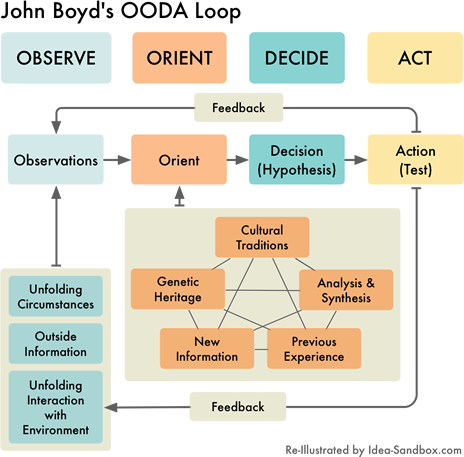
OODA stands for:
- Observe – Collect data with your senses. What’s actually happening right now?
- Orient – Analyze and synthesize that information. What does it mean in context?
- Decide – Choose a course of action based on your perspective.
- Act – Take action on that decision.
Then you loop back to observing again. And again. And again.
The winner isn’t the person who makes one perfect decision. It’s the person who cycles through OODA faster than their competition, learning and adapting with each loop.
Why OODA Matters in 2026
Twenty years ago, you could spend weeks analyzing a market shift. Today? Your customers have already moved on by Thursday.
In 2026, the speed of business isn’t measured in quarters. It’s measured in hours. AI tools spit out competitive analysis in seconds. Social media turns small issues into brand crises before lunch. Customer expectations shift faster than your planning cycles.
You need to make good decisions quickly, not perfect decisions slowly.
Consider Spotify in 2023. When OpenAI announced voice mode for ChatGPT, Spotify observed the immediate threat to their podcast strategy. They oriented around what this meant for audio content. They decided to launch their own AI-powered features. And they acted within months, not years, rolling out AI DJ and other voice features.
They didn’t wait for the perfect strategy. They ran faster loops than their competitors, observing each result and adjusting. That’s OODA in action.
How to Build Your Own OODA Loop
The framework is simple. Using it effectively takes practice. Here’s how to put OODA to work this week.
Build Observation Rituals
Most managers don’t have an observation problem. They have a signal-to-noise problem. You’re drowning in data but starving for insight.
Create observation rituals. Every Monday morning, spend 15 minutes reviewing: What changed last week? What are customers saying? What did competitors do? What’s happening in adjacent markets?
The key is consistency. Boyd didn’t scan the sky once and call it good. He observed constantly. Make observation a habit, not an event.
Sharpen Your Orientation
Orientation is where most people stumble. You observe plenty, but you can’t figure out what it means.
This is where your frameworks matter. When you see a problem, use Bricks, Walls, Cathedral to understand if you’re looking at the real issue or just a symptom. Is this problem a brick that’s part of a bigger wall? Or is the wall actually part of a cathedral-sized challenge?
Ask: Why does this matter? What patterns am I seeing? How does this connect to what I know? Good orientation requires you to see context, not just facts.
Make Decisions With Tools, Not Gut Alone
Once you understand what you’re seeing, decide. Don’t agonize.
When you’re choosing between clear options, use simple tools. Three Simple Decision Making Tools like Pro/Con lists, scored Pro/Con, or PMI (Plus, Minus, Interesting) help you decide faster without being careless.
The goal isn’t perfection. It’s making a good enough decision while you still have time to act on it.
Act, Then Observe Again
Here’s the secret Boyd understood: action creates new information.
When you act, you change the situation. That’s when you start observing again. What happened? What did you miss? What surprised you?
This is why Champion Ideas: Built In Beats Bought In matters so much. When you include stakeholders early, you cycle through OODA loops together. Everyone observes, orients, decides, and acts as a team. You move faster because you’re not selling and reselling the same idea.
The loop is the point. You’re not trying to get OODA right once. You’re trying to cycle through it faster than everyone else.
When NOT to Use OODA
OODA isn’t for everything.
Don’t use OODA for long-term strategy. If you’re setting your three-year vision or defining your company’s core purpose, slow down. Think deeper. Get more perspectives. Use frameworks like 11 Ways to Restate Problems to Get Better Solutions to make sure you’re solving the right challenge.
Don’t use OODA when you need consensus across a large organization. The loop works for small, empowered teams who can act quickly. If you need 47 people to sign off, OODA will frustrate everyone.
And don’t use OODA as an excuse for being reckless. Fast decisions still require thought. They just don’t require analysis paralysis.
The Loop Is the Lesson
John Boyd’s insight wasn’t just about speed. It was about learning.
Every time you cycle through the loop, you get smarter. You observe better. You orient faster. Your decisions improve. Your actions get sharper.
The competitive advantage doesn’t come from running one OODA loop perfectly. It comes from running ten loops while your competitor is still on their first.
In 2026, the speed of business rewards the fast learner, not the perfect planner.
Build your observation rituals. Sharpen your orientation. Use simple tools to decide faster. Act, learn, and loop again.
Your competitor is already on their second loop. Time to catch up.
This post is a riff and update on the original Idea Sandbox “Decision Making Like A Fighter Pilot” article from 2011. Still as relevant as ever.